
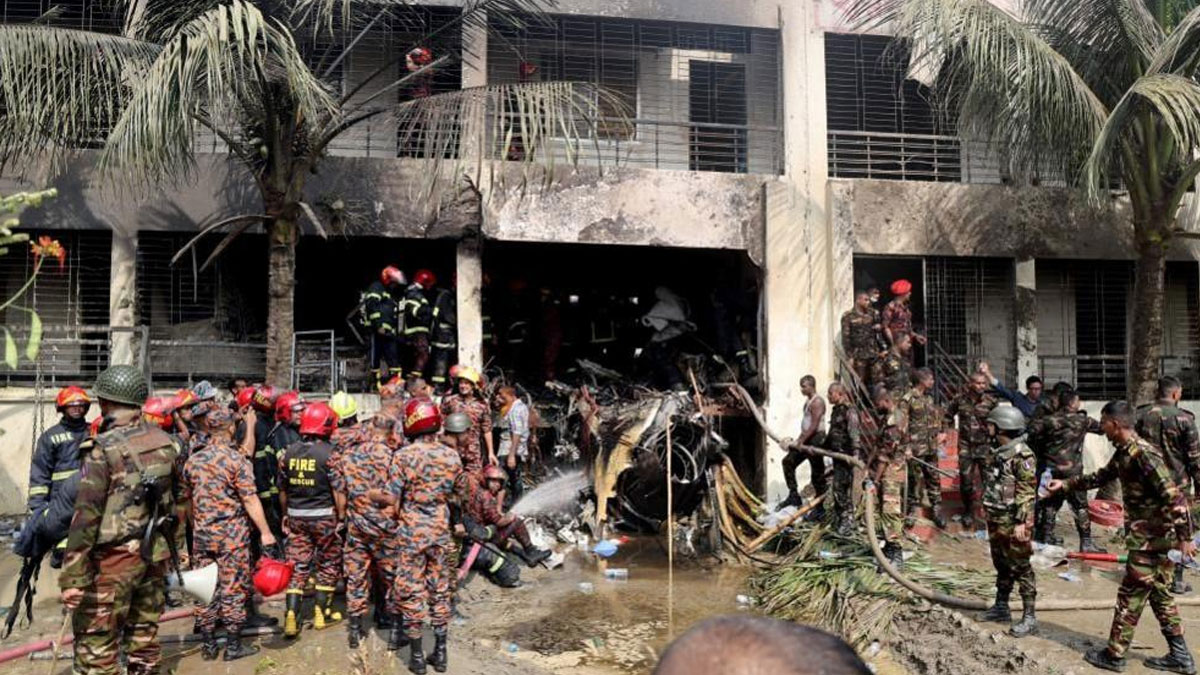

A tragic aviation accident in Bangladesh has resulted in the deaths of at least 19 people after a military aircraft crashed into a school building in a densely populated area. The incident has sent shockwaves throughout the country and raised serious concerns about the safety of conducting military flight operations near civilian infrastructure.
The incident happened during what authorities called a routine training session conducted by the Bangladesh Air Force. The plane, a fighter jet used for flight exercises and pilot instruction, experienced mechanical issues shortly after it departed. In spite of noticeable attempts by the pilot to steer clear of residential areas, the jet descended and eventually hit a school building that was in use at that moment.
Neighborhood witnesses mentioned perceiving a prominent blast and subsequently observed a plume of smoke ascending from the location of the accident. Shortly after, fire consumed sections of the school and nearby buildings. First responders, such as firefighters, law enforcement, and medical teams, reached the scene rapidly, yet the blaze’s severity along with dispersed debris made rescue endeavors challenging. Numerous students, educators, and onlookers were among the deceased, with several others injured and swiftly taken to local hospitals.
Officials have stated that the number of victims could increase as rescuers keep combing through the wrecked structures. A minimum of twelve people are receiving treatment for serious burns, broken bones, and injuries related to trauma. The status of some is still critical.
The pilot’s status has yet to be officially confirmed, though reports suggest that a last-minute attempt was made to eject from the aircraft. Investigators are analyzing the cockpit’s flight data and black box to piece together the sequence of events that led to the crash. Initial findings suggest a mechanical failure, but a full inquiry has been launched to determine the root cause and identify any lapses in safety protocols.
In a statement, military officials expressed their condolences to the victims’ families and pledged full cooperation with civilian authorities conducting the investigation. They emphasized that the flight was part of a scheduled training routine, adhering to all existing operational guidelines. However, this assertion has done little to ease the anger and grief felt by the local community.
El suceso ha provocado una vez más el debate sobre la cercanía de las operaciones militares a las zonas civiles pobladas. A medida que las ciudades de Bangladesh siguen creciendo, las líneas divisorias entre las bases aéreas y las áreas residenciales o educativas se han vuelto menos definidas. Grupos de la sociedad civil, líderes locales y defensores de la educación están ahora pidiendo una revisión de las rutas de vuelo militares y una implementación más estricta de las medidas de seguridad.
People living in the impacted region recounted the accident as a terrifying incident that happened in a matter of moments. Numerous individuals remembered witnessing kids running out of schoolrooms, guardians arriving frantically, and emergency responders courageously facing heat and smoke to access those trapped within the debris. Those who survived talked about broken windows, falling walls, and disorderly scenes as pupils attempted to flee through hallways filled with dust and fire.
Schools in the region have temporarily suspended classes in mourning, and government officials have announced compensation for the families of those who lost their lives. Psychological support services are also being made available to help students and staff cope with the trauma.
In Dhaka, the country’s leaders observed a period of silence in parliament, committing to reassess the nation’s aviation safety regulations. The Ministry of Defense, alongside the Civil Aviation Authority, is conducting a comprehensive evaluation of the risks associated with military flight activities, especially those close to educational institutions, medical facilities, and living districts.
The tragedy has also drawn international attention, with neighboring countries and global organizations extending condolences and offering assistance. Human rights groups have urged Bangladeshi authorities to prioritize transparency in the investigation and take urgent steps to prevent similar accidents in the future.
Experts in aviation safety stress that while aircraft malfunctions are not always preventable, minimizing their impact through better planning and risk management is possible. They point to international best practices that restrict low-altitude military flights in high-density areas and emphasize the importance of routine maintenance, pilot training, and updated emergency response protocols.
Bangladesh, similar to other countries, confronts the issue of aligning national defense priorities with the safety of its citizens. As the military upgrades and increases its training activities, safeguarding surrounding communities from potential risks is essential. There is an increasing demand to move training sites, enhance monitoring, and improve collaboration between military forces and civil administration following this unfortunate incident.
The individuals in the community impacted by the accident are also calling for responsibility and ongoing assistance. In addition to the direct physical harm, the psychological impact of the event will probably leave a lasting impression. For the families who lost relatives and the youngsters who observed the tragedy, the path to recovery will be extensive.
As the country mourns, attention shifts to taking steps to ensure that this tragic loss results in significant reform. The aim should be to stop such catastrophic incidents from happening again, whether by implementing policy changes, improving safety measures, or fostering more mindful urban development. The accident has highlighted the critical requirement for a review of the interaction between military and civilian concerns, particularly in a nation experiencing rapid urban growth.
The coming weeks will be critical as investigators analyze evidence, authorities outline policy responses, and communities begin to recover. For Bangladesh, the tragic loss of life is a painful reminder of the importance of vigilance, preparedness, and a commitment to protecting every citizen—especially the most vulnerable.
