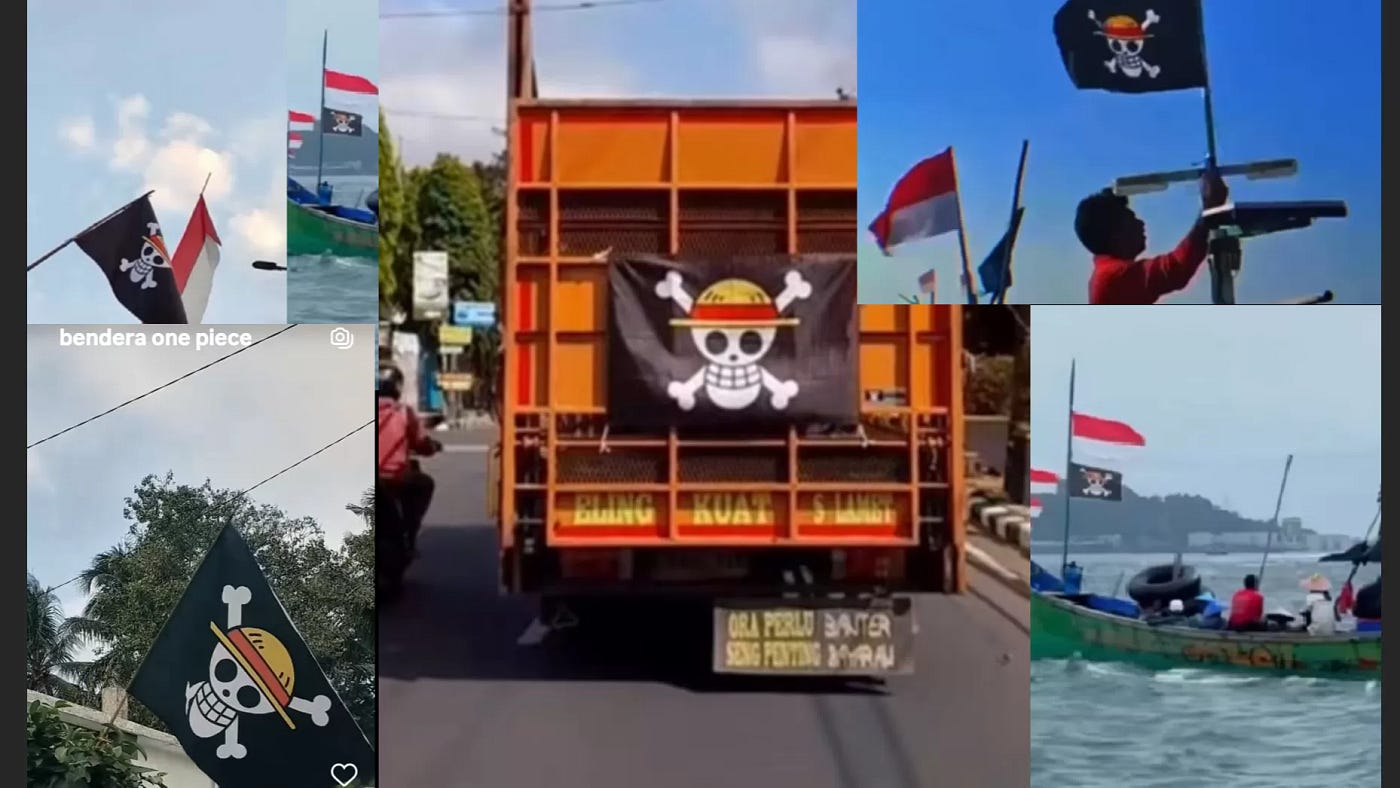

In recent times, an eye-catching yet subtle depiction has surfaced as a powerful sign of resistance throughout Indonesia—a whimsical skull, typically illustrated with striking outlines and bright hues. At first sight, it might seem like a work of street art or a piece of alternative graphic design; however, it has evolved into a collective emblem for activists, creatives, and regular individuals resisting against oppression, dishonesty, and societal injustice. The ascent of this emblem from being little-known to widely recognized is not merely a tale about art; it captures Indonesia’s intricate political milieu, the influence of grassroots efforts, and the timeless human aspiration for liberty and self-expression.
Determining the precise beginnings of the cartoon skull as a representation of resistance is challenging, as it arose naturally from Indonesia’s underground art and protest communities. Unlike government-approved imagery or corporate trademarks, this symbol wasn’t created through formal means. Rather, it originated from the streets—stenciled on walls, featured on homemade protest signs, and distributed on social media by those opposing authority.
Some trace its roots to the punk and anarchist subcultures that have long thrived in Indonesia’s urban centers. Others link it to the DIY (do-it-yourself) ethos of independent artists who use bold, easily reproducible imagery to bypass censorship. The skull’s exaggerated features—often grinning, sometimes adorned with slogans or motifs—make it instantly recognizable, allowing it to spread quickly among activists who need symbols that can be replicated under oppressive conditions.
Skulls have long been used in art and symbolism to represent rebellion, mortality, and defiance. From the Jolly Roger of pirates to the calaveras of Mexican Day of the Dead traditions, skull imagery carries a universal weight. In Indonesia, the cartoon skull takes on additional layers of meaning.
For one, its playful yet unsettling appearance makes it an effective tool for satire. By using a cartoonish style, artists and protesters subvert the fear typically associated with skulls, turning it into something that mocks authority rather than cowers before it. The exaggerated grin can be read as a smirk against corrupt politicians, abusive corporations, or oppressive laws.
Additionally, the simplicity of the skull is crucial to its effectiveness as a symbol of resistance. In contrast to intricate political manifestos or elaborate slogans, a thoughtfully created image can instantly express opposition. It transcends translation, overcomes literacy challenges, and allows for limitless adaptation—whether it’s spray-painted on a protest sign, featured on a T-shirt, or distributed as a digital sticker.
The rapid spread of the cartoon skull owes much to social media. In a country where mainstream media is often controlled or influenced by political elites, platforms like Twitter, Instagram, and Telegram have become vital spaces for dissent. Activists use these channels to share the symbol alongside hashtags related to labor strikes, environmental protests, and anti-corruption campaigns.
One of the reasons the skull prospers on the internet is due to its versatility. It is reimagined by digital artists, who incorporate additional elements to align with various causes, such as a gas mask for environmental demonstrations, broken chains for labor movements, or a scholar’s cap for student protests. Each version strengthens the emblem’s fundamental message while enabling diverse groups to adopt it as their emblem.
Authorities have tried to suppress its circulation, flagging posts containing the skull or even arresting individuals for displaying it. But these crackdowns often backfire, as heavy-handed responses only amplify the symbol’s rebellious appeal. The more the government tries to erase it, the more it becomes a badge of honor for those who resist.
Indonesia has a complicated relationship with dissent. While the country transitioned to democracy after the fall of Suharto’s authoritarian regime in 1998, freedom of expression remains contested. Laws against defamation, blasphemy, and “spreading hatred” are often used to silence critics, and protest symbols are frequently criminalized.
The cartoon skull has faced similar scrutiny. Authorities have labeled it as “anarchist,” “subversive,” or even linked it to extremist groups in an effort to discredit its users. Police have detained protesters for carrying banners featuring the skull, and state-aligned media occasionally runs segments warning against its “dangerous influence.”
Yet, rather than fading away, the symbol has only grown stronger. Each attempt to suppress it reinforces its role as a marker of resistance. When the government treats a drawing as a threat, it inadvertently confirms the power of art as a tool of protest.
El cráneo de caricatura no es único en su propósito: se une a una larga tradición de símbolos adoptados por movimientos de resistencia en todo el mundo. El puño en alto, empleado por activistas del Poder Negro y movimientos laborales, representa unidad y fuerza. La máscara de Guy Fawkes, popularizada por V for Vendetta y Anonymous, simboliza el anonimato y la rebelión contra la tiranía. Incluso algo tan sencillo como un imperdible se ha usado como señal de solidaridad con grupos marginados.
What makes Indonesia’s skull distinct is its deep connection to local struggles. It is not an imported symbol but one that emerged organically from the country’s own history of dissent. It resonates because it reflects Indonesian humor, resilience, and creativity in the face of adversity.
As long as inequality, corruption, and repression persist in Indonesia, the cartoon skull will likely remain a fixture of protest culture. Its meaning may shift—what represents labor rights today might symbolize climate justice tomorrow—but its core function as a tool of defiance endures.
Possibly the most notable feature of this emblem is its widespread availability. It is not owned by any individual or organization; rather, it is available to anyone who chooses to use a spray can, post a picture on the internet, or display it proudly. In an era where opposition is more frequently monitored and suppressed, the ability of a straightforward illustration to continue to disturb authorities highlights the lasting power of united defiance.
The transformation of the cartoon skull from an obscure piece of art to a widespread emblem of rebellion highlights that opposition isn’t always expressed through powerful speeches or military revolts. Occasionally, it takes the shape of a smiling visage on a mural, a widely circulated image on a smartphone, or a sticker affixed to a public signpost.
In Indonesia, where the liberty to speak is frequently challenged, the enduring presence of this emblem demonstrates that concepts are not easily dismissed. The skull represents more than a mere visual; it is a declaration, a defiance, and an assurance that the pursuit of justice will persist, advancing with each decisive gesture.